RACING SAFELY

Engineering SAFETY Beneath the Surface

Building and racing a submarine is a complex engineering challenge.

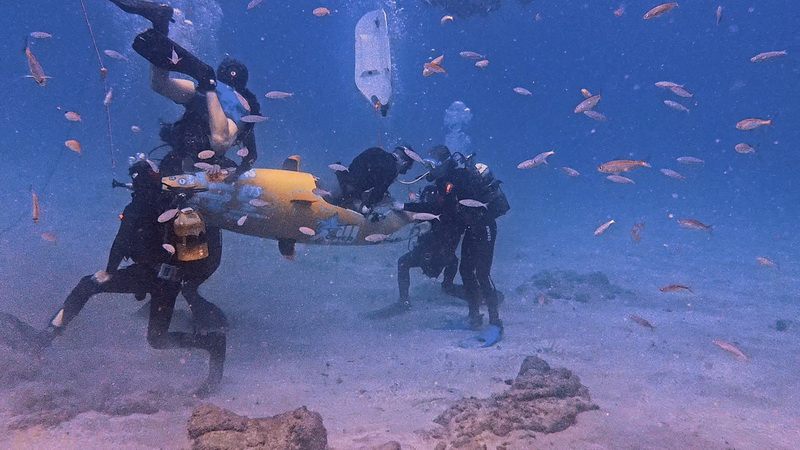
Unlike a racing car or an aircraft, a submarine operates in an environment where the crew must take their breathing air with them and must plan and monitor consumption.  Competitions use ‘wet’ submarines with pilots breathing from SCUBA equipment and can encounter currents, downdrafts and curious marine life.  Every design decision affects the safety of the pilots, their support team and everyone involved in the event.

For that reason, safety is something each team must focus on at the start of the design process.

It is where every successful racing submarine begins.

NEW IDEAS WITH EVERY ROUND

When the first teams raced human-powered submarines at Riviera Beach in Florida over thirty years ago, they were exploring completely new territory.

Every competition since has generated new ideas, revealed new challenges and improved understanding of how people, machines and the underwater environment interact.

By combining attention to detail with proven operational and management procedures the sport has maintained a 100% safety record with no significant injuries or dangerous incidents.

Today’s competitors benefit from more than three decades of engineering experience and success gathered from hundreds of successful dives and races.

Understanding the Risks

A racing submarine operates in an environment that naturally presents hazards.

The crew must have sufficient breathing air throughout the dive. Their submarine must remain stable and controllable underwater. It must avoid collisions with other submarines, support craft and the seabed. Above all, the pilots must always be able to leave the submarine quickly if circumstances require, and plan the races to avoid decompression sickness.

These are not unexpected risks.

They are the engineering problems that every competing team is expected to solve, and to demonstrate their solutions at pre-race scrutineering.


Safety Starts from the First Concepts

Detailed plans, careful study, confirmation by certification agencies such as DNV and Lloyds Registry, and exhaustive testing have long been the mandatory preparations before deep sea submersibles and commercial submarines are launched.  While smaller and lighter, before a subracer enters the water, every aspect of its design is examined with the same rigour and attention to detail.

Teams must demonstrate how their submarine maintains neutral buoyancy, how it remains controllable, how electrical systems are protected from water, how the materials and construction protect the pilots in cases of impacts.

Their racing submarine may be small, but the engineering and safety challeneges are full scale.

If these questions cannot be answered convincingly, the team and submarine will not race.

Designed to Protect the Pilots

Every submarine entered into the SubRacing Series Design Competition must satisfy mandatory technical and safety requirements before it is permitted to compete. These requirements place particular emphasis on crew protection, structural integrity, emergency procedures and reliable operation throughout the event.

The objective is straightforward.

Every pilot enters the water with confidence that the submarine has been designed, built and tested against clearly defined safety standards.


They are the engineering problems that every competing team is expected to solve.


Safety Doesn't Stop at the Submarine

A safe event depends on much more than the vehicle itself.

Professional dive supervisors, rescue divers, first aid teams, surface crews and event controllers all work together throughout every session. Rescue plans are rehearsed, communications are established, weather and sea conditions are monitored continuously, and specialist medical facilities such as hyperbaric chambers are identified before racing begins.

Every member of the event team has a clearly defined role.


Safety is Everyone's Responsibility

The SubRacing Series encourages innovation, ambitious engineering and exciting competition.

But there is one principle that sits above every race result.

No trophy is ever worth compromising safety.

By combining innovative engineering with rigorous design reviews, experienced safety professionals and internationally recognised operating principles, the SubRacing Series is creating a sport where world-class engineering and world-class safety develop together.


Safety Downloads Available:


Download and read more details about our approach to Safety in our Safety Strategy document.

Read our Latest Safety Newsletter


A Project endorsed by the United Nations Decade of Ocean Science for Sustainable Development,
affiliated with UNESCO-CoastPredict: Observing and Predicting the Global Coastal Ocean